


Vitamin C is one of the few vitamins your body cannot produce or store. It needs it every day, and winter is precisely the season when your plates provide the least.
Here is why, and how to make the most of it, from the inside out.
Why doesn't the human body produce vitamin C?
Because humans lost this ability during evolution. Most mammals produce their own vitamin C from glucose, thanks to an enzyme called L-gulonolactone oxidase.
In humans, the gene for this enzyme no longer works. We share this peculiarity with only a few species, such as great apes and guinea pigs. Result: all the vitamin C you need must come from your diet.
Why do you need to get it every day?
Because your body does not store it. Vitamin C is water-soluble, meaning it dissolves in water. What the body does not use is eliminated, instead of being set aside like some other vitamins.
A good intake on Monday therefore does not compensate for a deficiency on Wednesday. ANSES recommends 110 mg per day for an adult.
Why are we more likely to lack it in winter?
Because our plates change. As soon as the cold sets in, soups, gratins, and stews replace salads and raw vegetables.
However, vitamin C is fragile. It degrades with heat, air, and cooking water: a vegetable boiled for a long time loses a significant portion. Therefore, even a winter diet rich in vegetables often provides less than it seems.
The right seasonal reflex
Winter is also the season of citrus fruits. Clementines, blood oranges, grapefruits: enjoy them, they are packed with vitamin C. Eat them raw, they keep it intact. And a kiwi at breakfast already covers a good part of your daily needs.
What does vitamin C bring you every day?
It acts on three things you feel particularly in winter: your energy, your balance, and your skin.
- Your energy: it helps reduce fatigue, just as the days get shorter.
- Your balance: it contributes to normal psychological functions and the normal functioning of the immune system.
- Your complexion: it contributes to the normal formation of collagen, which supports skin firmness and radiance, and helps protect cells from oxidative stress.
These benefits are part of the health claims authorized by European regulations.
How to benefit from vitamin C from the inside?
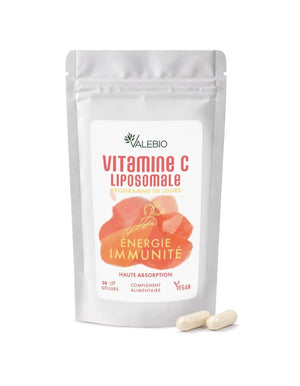
With a diet rich in raw fruits and vegetables, and if needed, a dietary supplement. This is why we chose to offer you the Valebio Liposomal Vitamin C.
Its peculiarity is its liposomal form. Vitamin C is enveloped in thin lipid spheres that protect it from stomach acidity. It is released gradually and better absorbed by the body.

Valebio Liposomal Vitamin C
- 300 mg of vitamin C per capsule · 375% of the reference nutrient values
- 1 capsule per day, during a meal, in the morning or at noon
- Course of 1 to 3 months, renewable
- Plant-based capsule · Vegan · Gluten-free · Made in France
And on the skin, how to use vitamin C?
With skincare products where vitamin C remains intact until the last use. It is the same fragility as in cooking: upon contact with water and air, vitamin C oxidizes and loses its effectiveness.
Our vitamin C skincare products are in powder form, so without water. Vitamin C only activates at the moment you use it.
The Radiance & Softness Powder Face Cleanser

Concentrated in vitamin C and AHA from hibiscus flowers, it gently cleanses the skin. Its enzymatic exfoliation awakens the complexion, without aggressive scrubbing.
The Radiance & Anti-wrinkle Powder Serum Vita C Peptide 10

The first powder serum with 10% naturally sourced vitamin C, combined with an anti-wrinkle peptide and a prebiotic. Without water, its vitamin C does not oxidize: it remains stable until the last use.
The two together form the Activated Vitamin C Face Routine. To combine skincare and supplements daily, discover also our vitamin C In & Out course.
Free Valebio Liposomal Vitamin C
For any purchase of €60 or more on yodibeauty.com, we offer you a pack of 30 capsules, i.e., one month of course. It is offered directly in your cart, without a code, while supplies last.
Frequently Asked Questions
Are you at risk of lacking vitamin C in winter?
Yes, the risk is greater in winter. Your body does not produce vitamin C and does not store it: it depends on your daily intake. However, winter dishes are often cooked, and cooking destroys part of the vitamin C. Raw citrus fruits and kiwis, or a course of liposomal vitamin C, complete your intake.
How much vitamin C is needed per day?
ANSES recommends 110 mg per day for an adult. The body does not keep vitamin C in reserve, this intake must therefore be renewed every day. One capsule of Valebio Liposomal Vitamin C provides 300 mg.
What is liposomal vitamin C?
It is a vitamin C enveloped in thin lipid spheres, called liposomes. They protect it from stomach acidity. Vitamin C is thus released gradually and better absorbed by the body.
Why does vitamin C in cosmetics lose its effectiveness?
Because it oxidizes upon contact with water and air. In a liquid serum, it gradually degrades after opening. In powder form and without water, Yodi skincare products keep their vitamin C intact until the last use: it only activates upon contact with water, at the moment of application.
Why combine a supplement and skincare with vitamin C?
Because they act in two complementary ways. The supplement acts from the inside: it contributes to the normal formation of collagen and to reducing fatigue. Skincare products act directly on the skin, for the radiance of the complexion. Together, they form the In & Out course.
Who should seek advice before taking a vitamin C supplement?
The Valebio supplement is suitable from 10 years old. Pregnant or breastfeeding women and younger children should seek advice from a healthcare professional before any supplementation. A supplement does not replace a varied and balanced diet.
Precautions for use: from 10 years old. Do not exceed the recommended daily dose. A dietary supplement does not replace a varied and balanced diet nor a healthy lifestyle. Pregnant and breastfeeding women consult a healthcare professional before any supplementation. Keep out of reach of young children. The effects described reproduce the claims authorized by European regulations.
Sources: ANSES, "Vitamin C", nutritional references and food sources · Commission Regulation (EU) No 432/2012, list of authorized health claims · Nishikimi M. et al., "Cloning and chromosomal mapping of the human nonfunctional gene for L-gulonolactone oxidase", Journal of Biological Chemistry, 1994.
Read: the vitamin C In & Out course, skincare and supplements for radiance
Read: vitamin C and skin, the star active ingredient provided it arrives intact
Take the skin diagnostic in 5 questions